Understanding the condition
What Is Frozen Shoulder (Adhesive Capsulitis)?
Frozen shoulder — known clinically as adhesive capsulitis — is a condition in which the capsule surrounding the shoulder joint becomes inflamed, thickened, and progressively scarred. As the capsule contracts, the joint loses its normal volume and mobility, resulting in severe pain and dramatically reduced range of motion in all directions.
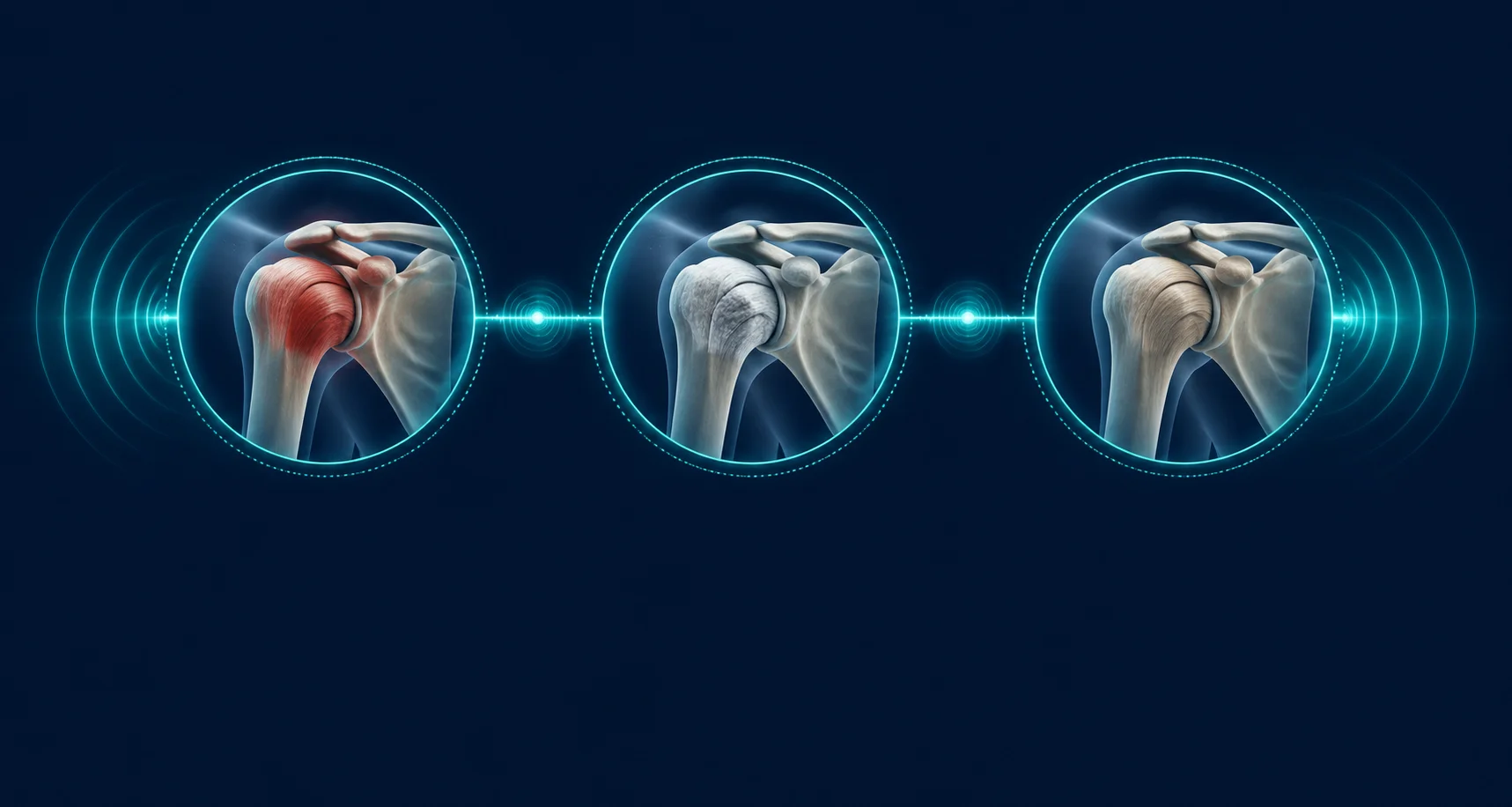
It affects approximately 2–5% of the general population and is significantly more common in people aged 40 to 70, in women, in those with diabetes, thyroid disorders or cardiovascular disease, and in people who have experienced prolonged shoulder immobility. The condition progresses through three clinical stages — Freezing (6 weeks to 9 months of worsening pain and stiffness), Frozen (4–12 months of severe restriction with peak fibrosis), and Thawing (gradual partial recovery that can take 6 months to 2+ years). Without effective treatment, patients can endure two to four years of pain and disability — and for many, full movement never returns spontaneously.
The core pathology is the formation of dense fibrous adhesions within the joint capsule — particularly at the rotator interval, the inferior glenohumeral ligament, and the posterior capsule. These adhesions physically restrict movement and cause the agonising pain at end range. In the early and mid-stages, the capsule is flooded with inflammatory mediators including Substance P and CGRP — chemicals that drive both pain and further fibrosis. The fundamental limitation of conventional treatments is that they address the pain but not the underlying process: the fibrotic contraction of the joint capsule. Focal shockwave therapy is one of the few interventions with the biological mechanism to directly target and reverse capsular fibrosis.
Many of our frozen shoulder patients have been told to simply wait it out. After years of pain and restriction, they arrive having run out of patience — and with good reason. They should not have had to wait.— Dr Kishore Bahl
The Three Stages — And Why Treatment Timing Matters
Stage 1 — Freezing
Duration: 6 weeks – 9 monthsGradual onset of shoulder pain, worsening with movement and at night. Range of motion begins to reduce. Inflammation of the capsule is active and progressive.
Stage 2 — Frozen
Duration: 4–12 monthsPain may ease slightly but stiffness becomes severe. Range of motion is significantly restricted. Capsular fibrosis and adhesion formation are at their peak.
Stage 3 — Thawing
Duration: 6 months – 2+ yearsGradual, spontaneous partial recovery. Full natural resolution can take years and many patients never regain full movement without intervention.
How it works
How Focal Shockwave Therapy Treats Frozen Shoulder
1 · Precise capsular targeting
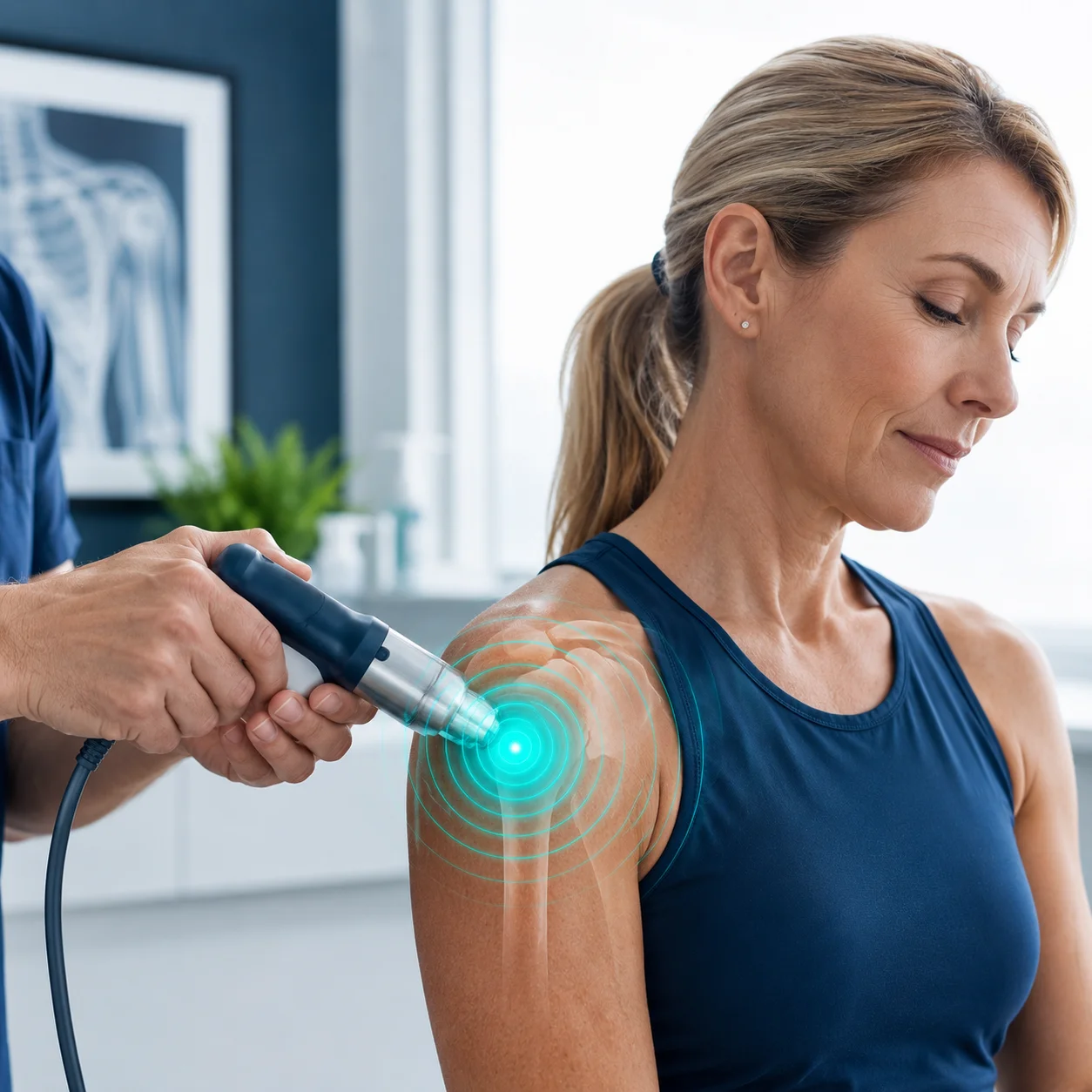
The joint capsule and key adhesion sites in frozen shoulder lie 3 to 6 centimetres below the skin surface — deep to the deltoid muscle. Radial devices cannot deliver sufficient energy density at this depth. Only focal shockwave technology, with adjustable penetration depth, can deliver concentrated energy precisely at the depth of the pathology — specifically the anteroinferior and posteroinferior joint capsule, the regions accounting for most movement restriction. (Dr Bahl, Chapter 14)
2 · Fibrosis breakdown and inflammation control
Focal shockwave energy disrupts the cross-linking of collagen fibres within the scar tissue adhesions, progressively softening and releasing them without surgery or force. Simultaneously it reduces Substance P and CGRP levels — breaking the cycle of neurogenic inflammation. Shockwave also stimulates TGF-β and VEGF, promoting healthy collagen remodelling — genuine structural repair, not temporary symptom suppression.
3 · Restoration of range of motion
As fibrosis softens and neurogenic inflammation reduces, the joint capsule regains its normal volume and compliance. Patients presenting with as little as 15–20° of shoulder abduction have achieved near-full overhead elevation within 3 to 4 sessions. Night sleep typically improves within the first 2 to 3 sessions. Protocol: 0.15–0.30 mJ/mm², 2,000–3,000 pulses, 4Hz, 4–6 sessions weekly. (Vahdatpour B et al. ISRN Rehabil 2014)
Find out
Is Focal Shockwave Therapy Right for Your Frozen Shoulder?
Focal shockwave therapy is suitable for frozen shoulder at any stage — Freezing, Frozen, or Thawing. The earlier treatment begins, the better the outcomes. Dr Bahl will assess your suitability at an initial consultation, review any imaging, confirm the diagnosis, and design a treatment plan specific to your stage and presentation.
Suitable for:
- Frozen shoulder at any stage (Freezing, Frozen, or Thawing)
- Patients who have tried physiotherapy with limited benefit
- Those who have had steroid injections with temporary or insufficient relief
- Patients with diabetes, thyroid conditions or cardiovascular disease (higher frozen shoulder risk groups)
- Post-surgical shoulder restriction and adhesive capsulitis
- Patients wishing to avoid surgery (hydrodilatation, MUA, or capsular release)
- Those who cannot tolerate general anaesthetic for surgical options
What to Expect
-
1Consultation — Full clinical assessment. Range of motion measured in all planes. Imaging review. Diagnosis confirmed. Red flags screened.
-
2Sessions — 4–6 sessions total, 20–30 minutes each. Weekly initially, progressing to fortnightly as improvement is established.
-
3The treatment — EMS Dolorclast focal handpiece. 3,000–3,400 shockwaves per session at 0.09–0.30 mJ/mm². Adjusted in real time to your comfort and response. No anaesthetic required. Drive home immediately after.
-
4Early improvement — Most patients notice meaningful improvement in pain and movement from session 2–3 onwards.
-
5Home exercise programme — Personalised exercises to consolidate gains in range of motion between sessions.
-
6Full effect — Continued improvement over 8–12 weeks as capsular tissue remodels.
Clinical comparison
Why Standard Treatments Often Fall Short
| Treatment | What It Does | Limitations | Versus Shockwave |
|---|---|---|---|
| Physiotherapy | Maintains and gently improves range of motion | Slow progress; limited effect on capsular fibrosis; very long treatment course | Shockwave is complementary — addresses fibrosis; rehabilitation consolidates gains |
| NSAIDs / painkillers | Reduces pain and inflammation temporarily | Does not address the capsular pathology; temporary symptom management only | Shockwave targets the mechanism, not just the symptom |
| Corticosteroid injection | Reduces inflammation, may ease pain for weeks | Temporary effect; limited to 2–3 injections; does not resolve fibrosis | Antagonistic with shockwave — wait 6–8 weeks between injection and shockwave course |
| Hydrodilatation | Mechanically stretches the capsule | Variable results; can be painful; recurrence common | Shockwave achieves capsular change through biological remodelling rather than mechanical force |
| Manipulation under anaesthesia | Forcibly breaks adhesions | Risk of fracture, nerve damage; requires general anaesthetic; significant trauma | Shockwave achieves progressive release without anaesthetic or fracture risk |
| Surgery (capsular release) | Surgically divides the contracted capsule | Invasive; significant recovery; reserved for severe cases | Shockwave is appropriate non-surgical first-line before surgery is considered |
| Focal shockwave (ESWT) — Shockwave ReVibe Clinic | Breaks down fibrosis, reduces Substance P, promotes capsular remodelling | None — non-invasive, no downtime, no needles | Results: patients recovering from 15–20° to near-full elevation within 3–4 sessions |
Source: Dr Kishore Bahl — Shockwave Therapy in Clinical Practice, 2026. Chapter 14, Table 20.
Your Home Exercise Programme
All patients at Shockwave ReVibe Clinic receive a personalised home exercise programme to complement their shockwave sessions. These exercises are introduced progressively as movement returns and are designed to be gentle — never forced into pain.
Pendulum Circles
Lean forward, let arm hang freely. Small gravity-assisted circles using trunk momentum.
Twice dailyWand / Stick Assisted Elevation
Good arm drives affected arm upward into comfortable range using a walking stick or broom handle.
Daily, 10 repsSleeper Stretch
Lying on affected side, gentle downward pressure on forearm. Targets posterior capsule (key for internal rotation).
Daily, hold 30 secondsWall Walks
Fingers walk up wall to gradually increase elevation.
Daily, 10 repsScapular Retraction
Squeeze shoulder blades together gently. Improves scapular mechanics.
Daily, 15 repsIsometric External Rotation
Press back of hand into door frame without moving. Gentle rotator cuff activation — introduced once terminal pain reduces.
From week 2 onwardsWhat we offer
Treatment Benefits
Focal shockwave therapy at Shockwave ReVibe Clinic offers a range of clinically meaningful advantages for frozen shoulder patients.
Restores Full Range of Motion
By targeting the capsular fibrosis and adhesions that physically restrict movement, focal shockwave therapy restores shoulder mobility from the inside out.
Accelerates Natural Recovery
The natural history of frozen shoulder means waiting two to four years without treatment. Focal shockwave dramatically compresses this timeline, producing results within weeks rather than years.
No Surgery Required
Unlike manipulation under anaesthesia or arthroscopic capsular release, focal shockwave achieves capsular release without any incisions, needles, or general anaesthetic.

Frozen shoulder is one of the most debilitating yet underdiagnosed musculoskeletal conditions I treat. Focal shockwave therapy can restore full range of motion in patients who have been suffering for years — often within just a few sessions. It is the most mechanistically precise non-surgical option available for adhesive capsulitis.

Got questions?
Frequently Asked Questions
Related Treatments
Musculoskeletal Pain Therapy
Focal shockwave for calcific shoulder tendinitis, plantar fasciitis, tennis elbow and chronic tendon pain.
Sports Injury Treatment
Focal shockwave for Achilles tendinopathy, stress fractures and athletic injuries.
Chiropractic Service
GCC-registered chiropractic care from Dr TJ Kathiravelu — complementary to shockwave for shoulder and postural conditions.
From Our Blog
Evidence-based articles on frozen shoulder, shockwave therapy, and musculoskeletal health from our clinical team.
Frozen Shoulder • May 2026
Frozen Shoulder — How Focal Shockwave Can Set You Free
Everything you need to know about adhesive capsulitis — what it is, why it happens, and why focal shockwave therapy is producing results that surprise even long-suffering patients.
Read article →
Clinical Education • July 2026
Shockwave Therapy in London — The Full Guide
What shockwave therapy is, which conditions it treats, and why focal vs radial device choice determines whether treatment can work at all.
Read article →Don't Wait Years for Your Shoulder to Thaw
If you are living with frozen shoulder — whether newly diagnosed or having suffered for months or years — focal shockwave therapy at Shockwave ReVibe Clinic could restore your movement far sooner than you think. Patients recovering from barely lifting their arm to near-full overhead elevation in just three to four sessions. Every treatment is delivered personally by Dr Kishore Bahl at our Notting Hill Gate clinic.
Book a ConsultationBy booking an appointment you agree to our Privacy Policy
Find Us on Google
Share your experience — your review helps others find our clinic.